



















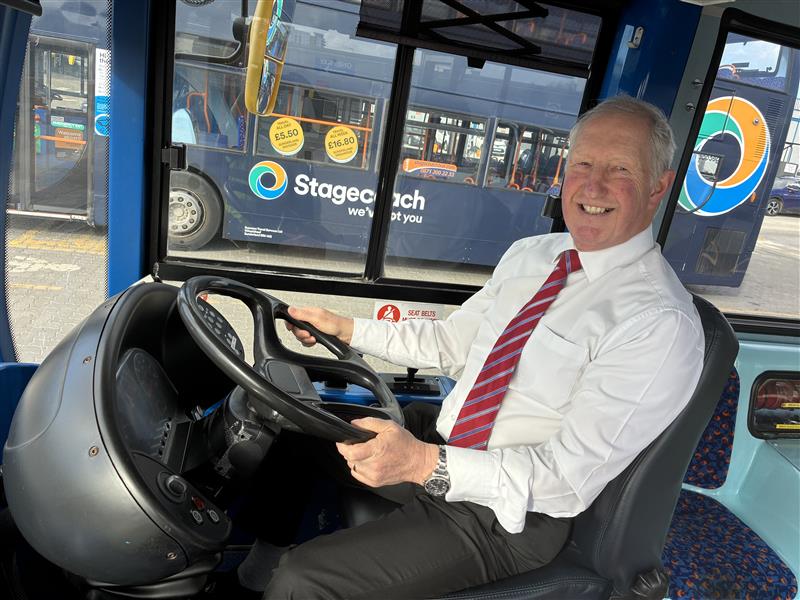
Stagecoach North East man Joe Carr retired this year after half a century as a driver, driver trainer and Driver Standards Manager. He has noted several changes over the years
After 50 years in the industry, one of Stagecoach’s longest-serving employees called time on his multi-faceted career earlier this year. Having begun as a driver and conductor for Tyne and Wear Passenger Transport Executive in 1976 and since worked for successors Busways Travel and Stagecoach in training-related roles, including as a Driver Standards Manager, Joe Carr has seen a lot of change in the bus sector.
At the age of 71, Joe looks back fondly on a varied career. Reflecting on his entry into the industry, he says: “I’d served my time as a vehicle repair technician, and I was tired of being dirty, and I was looking for something else. I just thought I’d try [driving] as a fill-in job.
“In those days, the recruitment was very quick. I went on the Friday afternoon for the interview, and they said, ‘If you can get a medical this afternoon, you can start on Monday,’ which I did.”
The switch to training
Joe, who worked for Stagecoach North East at its Sunderland depot, spent a few months as a conductor before acquiring his PSV licence. He started working as a driving examiner in 1987. After Stagecoach acquired Busways in 1994, he moved on to become a Driver Training Manager and then, in 2008, he was promoted to Driver Standards Manager.
The move to the training side came naturally, he says. “I’d always liked to help people and I imagined that would be the next step,” he explains. “There were quite a lot of drivers that were offered redundancy and left when deregulation came in; I think it was right across the country. There was a shortage of drivers, and they were advertising for instructors.”
The makings of a good driver
As the industry struggles to cope with a 3.4% shortage of bus drivers and 12.4% shortage of coach drivers, Joe reflects on why the role is not easy to fill. “I’ve seen people join who are probably not cut out to become bus drivers,” he says. “You’ve got to have a special kind of presence about yourself. I’ve seen people come in and I’ve thought from day one they’re not going to last very long. You can tell by their temperament.
“It takes a special kind of person to be dealing with the public. You get people who are cut out to be drivers, but who cannot deal with the public. You get others who can deal with the public, but who aren’t very good drivers. The people you need are in the middle, and they are very few and far between.”
Speaking of why he lasted half a century in the industry, he says: “I enjoyed meeting and helping people. I never found it to be hard work because I enjoyed it that much.”
Further, the industry presents excellent opportunity for career progression, he points out. “What I have found is that, when working for the big companies, the opportunities are always there, and you could progress within the company. I’ve seen, quite a number of times, people come into the industry as a management trainee that ended up being the Managing Director.”
A changing industry
Comparing the role of a driver now to when he started 50 years ago, he adds: “Driving the bus has become easier, with power brakes and a lot softer suspension, but dealing with the passengers has probably become harder. When I look back, it was very rare that we had any real problems on the bus, no violence, etc. But, over the last few years, it’s become more violent against the drivers.”
He has noted many other changes over the years: “It’s become more involved now to gain a PCV licence than when I started. You submitted the papers, did the training and took the test, without the need for theory tests and CPC. When I started, you weren’t given any sort of training with regard to dealing with the public; there was no customer-care side of training. The maximum fare was 15p when I started. Now they have to deal with so many different passes and permits.”
Joe, who had worked part-time since 2019, has mixed feelings when it comes to the changing technology in the industry. He says: “I saw the introduction of the first electronic ticket machines. It’s like anything that’s electronic – it’s fine when it works but, if you have a problem, you’re stuck.” He recalls that ticket machine maintenance used to be the realm of the driver. “If you kept your machine working in good order, it was an advantage to you,” he says.
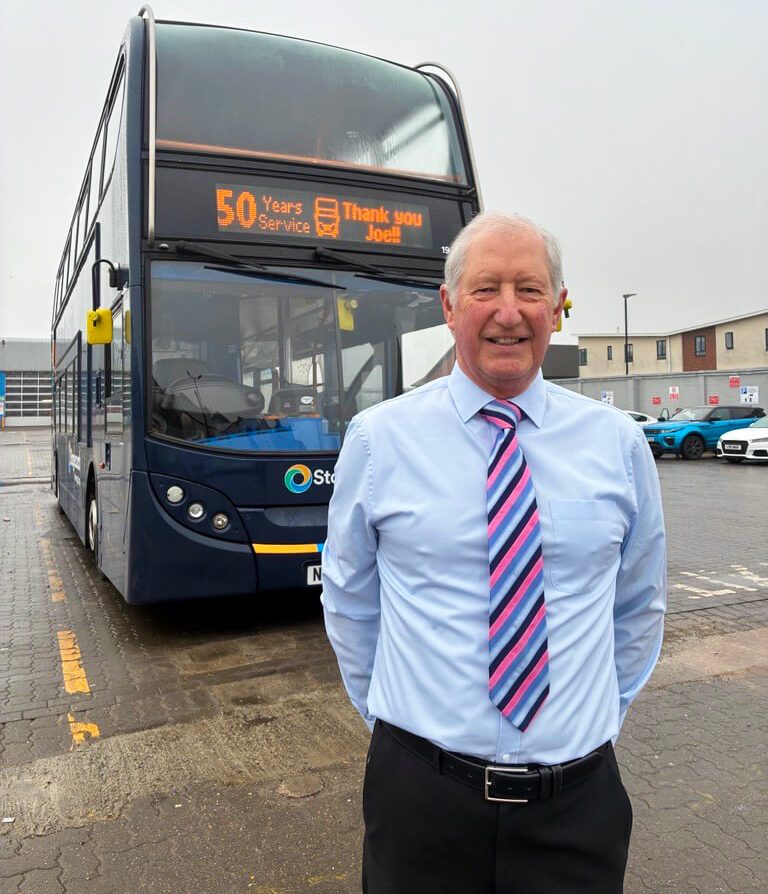
Colin Newbury, Operations Director for Stagecoach North East, pays tribute, saying: “Joe’s contribution to Stagecoach over the past 50 years has been exceptional.
“His commitment to safety, professionalism and developing people has had a lasting impact on our operation and on the many colleagues who have learned from him. Joe leaves behind an incredible legacy, and we’re hugely grateful for everything he has given to the business.”
Joe, who is now looking forward to spending more time at home with his wife, Maureen, and working on DIY projects, felt the time was right for the next stage in his life. “All good things must come to an end,” he says. “Fifty years, I think, was enough. Even though I’ve enjoyed it and physically I could have carried on, I thought it was time to hang the clipboard up.
“There’s bound to be more changes [in the industry]. I think Stagecoach will be well equipped to deal with them but, if not, they can give us a call!”