



















Exemptions to compliance with the Public Service Vehicles (Accessible Information) Regulations (PSVAIR) for in-scope rail replacement services come to an end in July and a range of solutions are now on the market to theoretically ensure a ready supply of suitable vehicles.
As well as systems from incumbent suppliers, the debut of four solutions in April from a competition staged by the Department for Transport (DfT) and Innovate UK promise less conventional and competitively priced options. Other solutions are provided by vehicle OEMs.
routeone examined some of these products to identify their intended applications and target users.
Note that the solutions covered here do not make up an exhaustive list, and operators are encouraged to do their own research to find what will best suit their needs.
Incumbents working hard
For operators undertaking regular rail replacement work, permanent solutions may present a logical investment.
Legacy solutions hardwired into the vehicles are available from the likes of Hanover and McKenna Brothers. The latter supplies products in partnership with Luminator, which owns digital display manufacturer Mobitec.
routeone spoke to Mike Elkin from Portsmouth City Coaches, who recently had a Mobitec screen fitted to a 2026 Temsa HD12. That vehicle was presented at the Blackpool Coach Rally in April. Autosound fitted the system on behalf of McKenna Brothers, and Autosound Managing Director Lee Fergus notes that fitters like himself are working round-the-clock on getting fleets ready for the July deadline.
The Mobitec solution links in with Hanover destination displays already integrated into the vehicle and other interior systems. Lee also uses induction loop systems from Elite Vehicle Supplies and Ardent, as well as professional service products from Bosch. Most coaches he works with are fitted with Hanover or McKenna Brothers-supplied destination blinds, meaning there is good compatibility when it comes to retrofits.
The Mobitec system features a scrolling LED display. It can be programmed either by McKenna Brothers or by the operator. Mike says the latter may sound daunting, but is made easier when a template has been set up. “It will take time, but when you work out how to do it, it’s fairly straightforward,” he says.
Plans are to fit the same system to a new MCV EvoSeti-bodied Volvo B8L, as well as two of the company’s 2025 EvoSetis.
Mike says he chose the permanent solution as he sees it as an “asset” in the vehicle, which will be advantageous when it becomes time to sell.
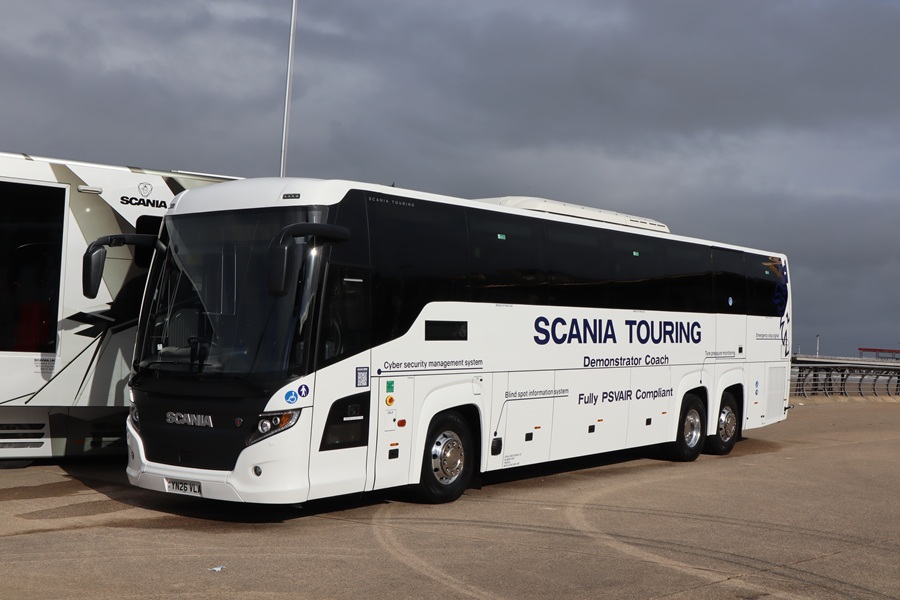
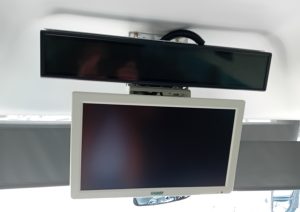
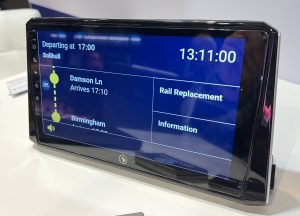
Scania meanwhile debuted its own PSVAIR package at the UK Coach Rally, with equipment from Elite Vehicle Supplies and Hanover on a Touring demonstrator (pictured above). Scania’s solution features a letterbox display mounted above the existing front-mounted monitor. That solution can also be specified on Irizar-bodied coaches.
Technology agnostic approach
Operators with newer fleets and whose physical hardware complies with requirements are given the option of a software-first approach through You. Smart. Thing., a tech supplier with a background in multi modal travel planning.
SmartCoach is a software overlay that can deliver passenger information where any PSVAIR requirement is needed, with a focus on the rail replacement use case.
A dashboard has been adapted to allow operators to ingest timetable services from aggregators (as well as to manually edit those services).
Andrew Steele, Chief Operating Officer at You. Smart. Thing., says the solution is ideal for operators with moderate aged fleets or newer coaches with good wiring looms, displays and PAs built in. “For next to nothing you can exploit that existing hardware, and turn it into a PSVAIR solution,” he says. “Our solution is probably better for slightly larger fleets, where data integration will save on operational costs. We can do a full integration flow from aggregators into the operator’s system, as opposed to them being used to programming their destination blinds themselves. That data flow for our solution is very much a selling point.”
A fleet readiness survey will determine whether the onboard screens, induction loop and PA system are compatible, identify any hardware requirements, and the software can be installed. “We are not in the hardware market, but we are looking to help operators be PSVAIR compliant at the lowest cost possible,” adds Andrew.
The platform is available for £95 per operational rail replacement coach per month.
A focus on robustness
Many coach operators will be familiar with the anxiety of undertaking rail replacement work, and the associated risks from less savoury passengers. Application Studio has therefore focused on robustness when it comes to its product Route Robin.
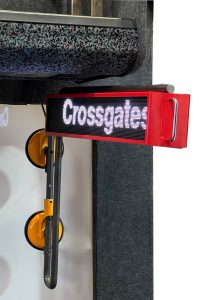
Route Robin uses a destination display inside a lockable steel enclosure that can be mounted via an interlocking system and suction cups to the window. Installation takes around five minutes for one person. It uses geofenced stop announcements and can operate without an internet connection. Routes can be planned via a Bluetooth app, or via a sim card and web portal package for £9.99 per month.
Application Studio’s Directors, Elliott Brown and Ben Broughton, say Route Robin is designed to replicate the experience passengers would expect to have on a train. “Our focus has been to look at the Regulations and boil them down into simple tick boxes,” says Elliot. “Then design a solution that meets those requirements.
“The kit is designed to be used for years, so the decisions we made are around making it difficult to tamper with, and something that nobody wants to steal.”
The solution can be used temporarily or fixed permanently on vehicles via a mounting point on the subframe. A portable induction loop can be supplied, and the system can be integrated with speakers for audio announcements. The product is available for a one-off price of £1,999.
Futureproofing fleets
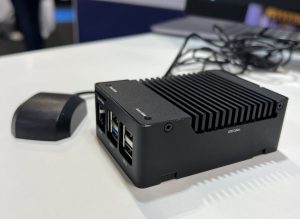
Maverick ML has unveiled a plug-and-play system called the Smart Accessible Information System (SAIS), which is currently available through a product it calls The Box.
SAIS is a PSVAIR tech solution running MaverickOS, which can be retrofitted to screens, PA systems and induction hearing loops already installed in vehicles. It is £950 plus VAT. There is no subscription fee.
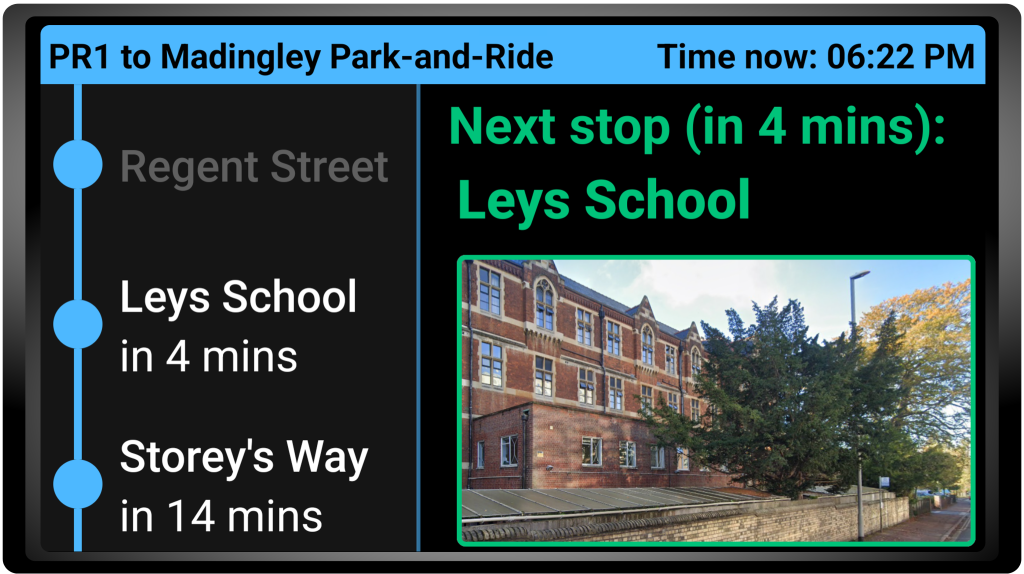
The system provides a visual display that presents live route information with a captured image of upcoming stops, final destinations, service changes and alerts. Highlighted are accessibility-friendly colour schemes, layouts and text, which Maverick says can be easily understood.
Dr Gishan Don Ranasinghe, Director of Maverick ML, highlights extensive real-world trialling for users with disability challenges, and there has been a particular focus on hidden disabilities in the design of SAIS.
Visual countdown timers display an estimated time of arrival to the next stop and factor in real-time traffic information. On-screen alerts highlight diversions, disruptions, and hail-and-ride sections. There are notifications for approaching stops, and final destinations. Announcements are transcribed into text using artificial intelligence (AI) speech-to-text technology. English and Welsh are supported.
The Box comes with a driver app and a web portal for planning rail replacement routes. Maverick ML will check compatibility, and operators can undertake a free trial for two weeks.
A fully integrated flagship model is expected to include the option of 21 or 24-inch screens supplied by Maverick ML. At time of writing, that is going through certification and is being prepared for market. Operators interested in the flagship model are encouraged to get in touch with the supplier.
Gishan says a key feature of SAIS is that it goes beyond PSVAIR and gives operators a “futureproof” and user-friendly fleet. “It satisfies PSVAIR, but this goes beyond the law,” he says. “AIR specifies audio and visual information, but it doesn’t go into detail about other disabilities. We explored cognitive disabilities through our research and development and looked into how we can integrate that feedback. Heart and mind both combined, and we have had the chance to understand those problems and make a difference with this solution.”
The lighter-touch approach
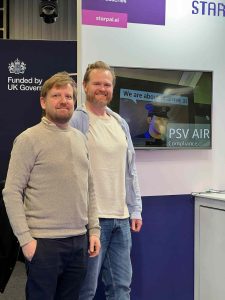
French supplier StarPal has introduced StarPal for Coaches, a portable kit that features screens, in-built speakers and a driver control device, leveraging AI.
StarPal says the solution has been designed to offer the “best possible cost to retrofit” and that it is suited to operators doing irregular or sporadic rail replacement work.
“When coach operators have to comply they face very pricey estimations for permanent systems,” says Jerome Dwavrin, StarPal CEO. “It means wiring, drilling, physical installation, and that’s expensive. There is also a long set up behind the computer — it’s quite a painful and long process, and that’s why many operators are considering avoiding rail replacement.”
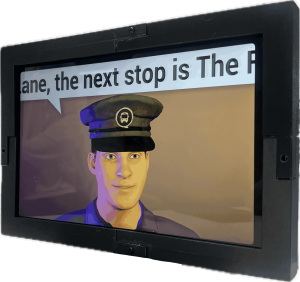
StarPal offers a “no retrofit” approach through the provision of two light screens that can be placed freely in the vehicle, for example, on the front bulkhead or atop the servery. A driver is supplied with a hands-off phone (or other device) that communicates geolocated announcements.
The most striking feature is a customisable, animated avatar on the screens, which the supplier calls George. George can be made to be either male or female, branded with an operator’s design, and speaks to passengers using AI, with broad multilingual capability. Announcements are via in-built speakers.
Jerome says neurodivergent passengers and those with partial hearing responded particularly well to George.
“When we first won the tender, we offered a solution to interact with an avatar in the coach,” says Daniel Anthony, StarPal Chief Technology Officer. “We understood the problem is primarily in the announcements, so we out all our efforts in this. Thanks to the guidance from DfT, we have focused on the main accessibility problem, which will open the door to interacting and asking questions to the avatar, for safety, instead of the coach driver.”
 The screens can be used on any vehicle regardless of age, and with mixed fleets, where StarPal says consistent retrofitting can be complicated. A web portal with an operator’s menu allows for routes to be programmed and StarPal says a drag-and-drop feature is in the works that will leverage AI to speed up the process.
Daniel says the supplier’s secret sauce is full and rapid support for both hardware and software. “We provide all help in terms of compliance,” he says. “There is a lot of fear and frustration from operators. We’re trying to take that away and handle things if they go wrong. We have partners and remote software support. We also handle telemetry and compliance. If a passenger says an announcement was not made, we can show evidence that the announcements and events are tagged and geo-timed. It’s full accountability from an operator’s end.”
Other features being explored include options to monetise with local advertising, which could generate passive income for operators, and avatars that can communicate in sign language.
The devices use a subscription model and there are also options to pay up front with discounts. Pricing starts from £150 per month per kit, with kits able to be shared across multiple vehicles.
Supplier promotion
StarPal is offering a dedicated discount for routeone readers, with six months’ free coverage included in a three-year contract. This promotion is solely administered by StarPal and routeone receives no commercial or financial benefit.