




















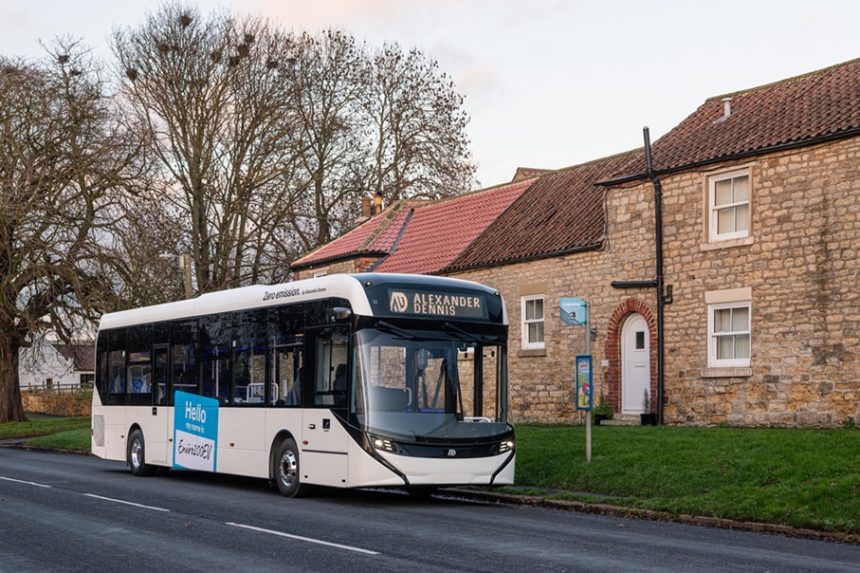
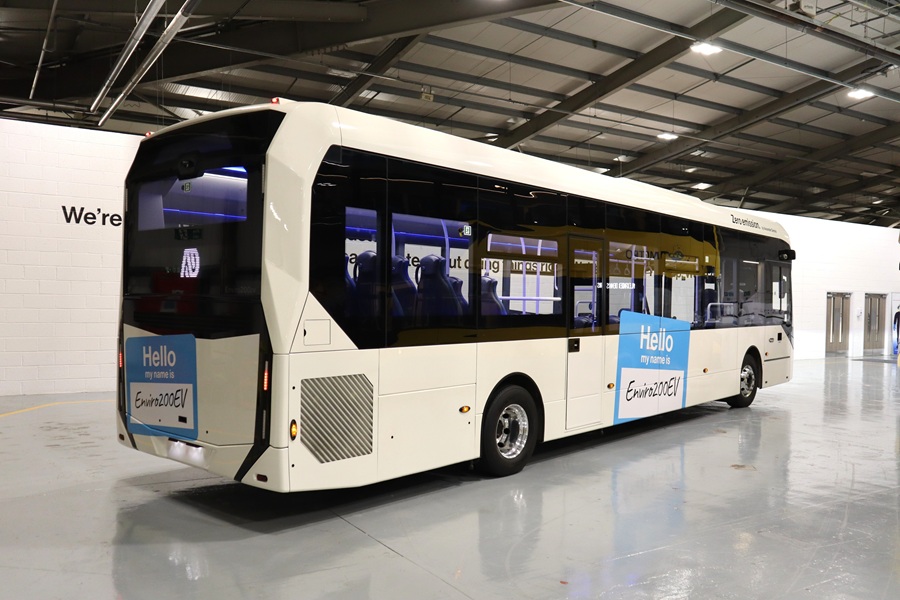
Alexander Dennis has completed its next-generation battery-electric bus line-up for the UK with debut of the Enviro200EV single-deck. The builder promises that the Enviro200EV will bring a new approach to its field through lightweighting and a leveraging of the benefits to the passenger environment that such a strategy fosters.
A test and development Enviro200EV was shown in January at the manufacturer’s Larbert headquarters to promote the wider battery-electric range to operators and stakeholders in Scotland, where a third round of the Scottish Zero Emission Bus challenge fund (ScotZEB3) is underway. It sat alongside the Enviro100EV small bus and the Enviro400EV double-deck.
Getting the next-generation Enviro200EV into service is now the priority, says Alexander Dennis President and Managing Director Paul Davies. Work towards that is well in hand; the first four production examples, for Go North East, are complete. From there, efforts will turn to those ordered by Falcon Buses and by First Bus for use in Bath.
While manufacturing at Larbert is currently paused, Alexander Dennis has confirmed that the Enviro200EV will be built in full at its plant in Scarborough. Previously, it had floated scope for bodyshells to be fabricated in China and shipped to the UK for fitout, as happens with the Enviro100EV.
Ability to build the new model in Scarborough has been accomplished by overhaul of how production is handled there. The Enviro100EV and Enviro200 diesel are handled in one building, and the Enviro200EV and double-deck models in another.
Although the test and development bus is to provincial specification at 11.7m, one to Transport for London (TfL) requirements is also complete. In both cases, the product comes at 9.9m, 10.9m and 11.7m; a 10.4m example will additionally be built exclusively to TfL layout.
Enviro200EV seeks its own place in battery-electric bus world
Alexander Dennis said early in the Enviro200EV development process that it would lean on the established Enviro200 diesel approach. That is verified by arrival of the first examples of the battery-electric product, as Paul explains.
Gross weight of the newcomer is 17,200kg. It uses 19.5-inch wheels. Keeping unladen weight down has been a priority and he observes that the Enviro200EV is up to 2,000kg lighter than some competitors. The unladen figure for the 11.7m provincial model is said to be around 11,500kg.
Acknowledging experience with the previous Enviro200EV built in partnership with BYD, significant work on ensuring sufficient body strength has gone into the next-generation variant – particularly around the axles – to support batteries that are on the roof, although not all energy storage is overheard.
It is instead split equally between there and what would otherwise be the engine bay. 12 battery modules are fitted to give 400kWh of capacity. Lithium iron phosphate chemistry is used. Power is transmitted via the Vehicle Electrical Drive System (VEDS) from Driventic, a supplier that was carved out from Voith in 2025.
Vehicle Electrical Drive System offers ‘portable asset’ scope
Alexander Dennis will build the Enviro200EV with VEDS in the driveline’s medium- and heavy-duty iterations. Paul notes that for shorter buses, the former will likely be most appropriate, but he caveats that by observing how for the longer examples, and where an operator needs higher road speeds either now or in the future as vehicles move from one application to another, the heavy-duty variant may be better.
“One customer has told us that they need 60mph capability, and the heavy-duty VEDS will deliver that,” he adds. The Enviro400EV is built with the heavy-duty package and performed well in certification by Zemo Partnership for the Zero Emission Bus Scheme that involves measurement of energy consumption.
The price difference between medium- and heavy-duty VEDS in the Enviro200EV is “not huge” and Paul notes that the latter will make the bus “a more portable asset” for some buyers. Brist axles are used. Charging is via a plug-in CCS2 connection at up to 150kW. Roof-mounted rails for use with inverted pantograph-based opportunity replenishment can be specified as an option.
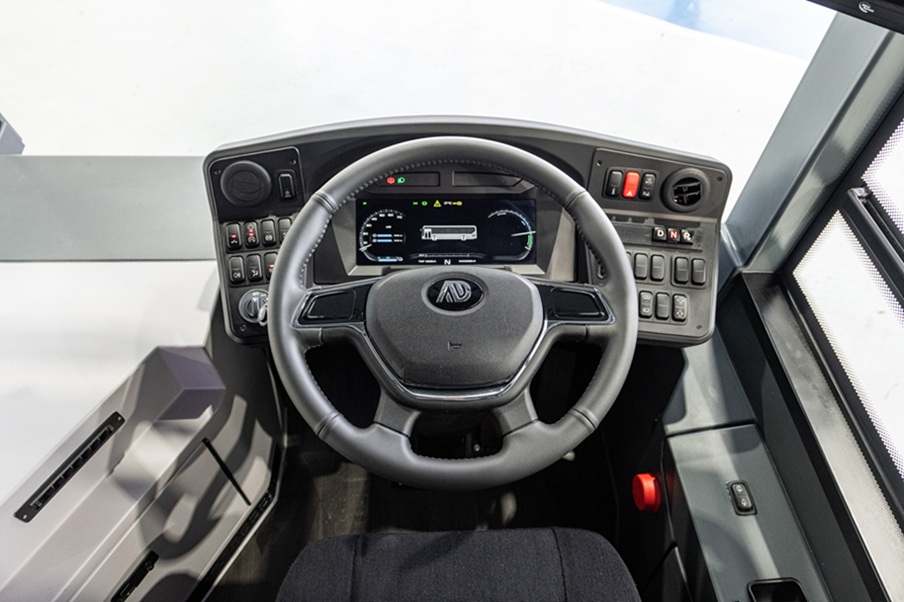
Interior a focus on Enviro200EV, bus builder says
He continues by outlining how Alexander Dennis had no interest in delivering a “me too” single-deck electric product with the Enviro200EV. Success with the diesel Enviro200 indicated strong customer interest in lighter vehicles.
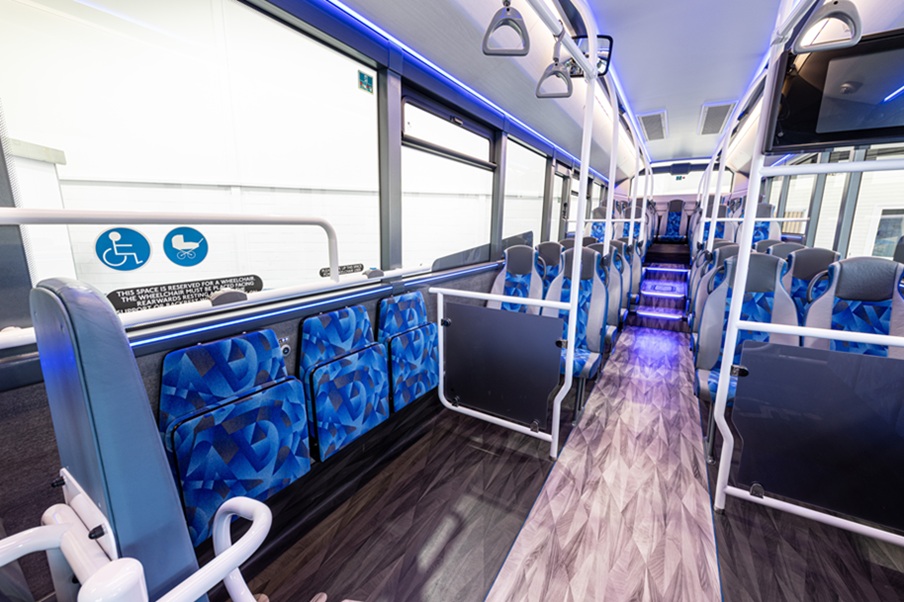
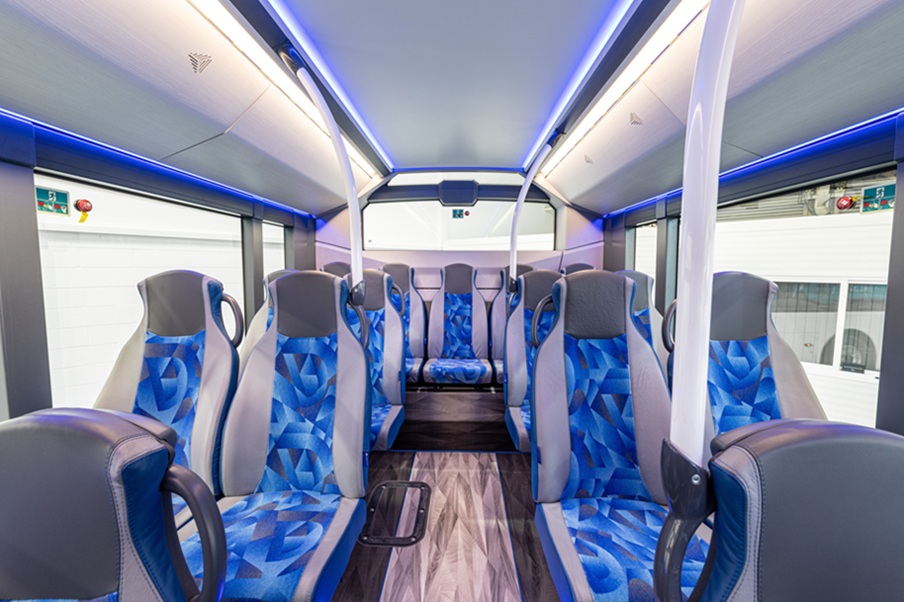
Smaller wheels reduce intrusion into the saloon and widen the ‘throat’ at the front, while at the rear, they allow a lower height to be achieved in the high-floor section. Coupled to a longer wheelbase than may otherwise have been the case and the result is a low-floor area that is extensive, as illustrated by the test and development bus.
Reachable without encountering a step are 16 forward facing seats. Twin wheelchair user bays are fitted to the bus in question, within which are a combined six tip-up positions. A further pair of seats on a pedestal are immediately behind the cab, while in the high-floor rear area are 17 more.
That gives 41 seats in total, although if one wheelchair user bay is chosen, the figure becomes 43. Maximum overall capacity at 11.7m is 92. Smaller provincial variants give up to 33 seats and 73 passengers at 9.9m, and a maximum of 39 and 84, respectively, at 10.9m.
The development bus has Lazzerini Practico seats. Forward-facing positions have a console with a USB charging point, a device holder and a stop request button. Air-conditioning is fitted using a roof-mounted unit that sits behind the batteries. It utilises a heat pump. Another for the cab is driven as a ‘slave’ off that for the saloon.
No ‘commoditisation’ for next-generation Enviro200EV
Particularly impressive on the Enviro200EV is how it is packaged at the rear. A person of more than 6ft in height can stand fully upright there, and expansive glazing without worry of modesty issues is a further benefit. Paul notes how the smaller wheels allow the Enviro200EV to be around 20cm lower than some competitors; that brings a small influence on energy consumption in having less saloon volume to heat or cool.
The Alexander Dennis chief believes that some battery-electric buses have been “commoditised” in a manner that can compromise the saloon layout to an extent. “We are unwinding that,” he continues, noting how making the Enviro200EV as similar internally to the diesel Enviro200 has been a priority.
Lead times are important, Paul continues. Pressure on those from customers does not relent. The Enviro200 when built for stock has seen success through rapid availability. It is not planned to build the Enviro200EV on an identical basis, but some element of stock assembly may form part of the long-term.
UK focus for Alexander Dennis, but overseas not forgotten
The Enviro200EV’s long wheelbase is considerate of UK expectations. Alexander Dennis is amid something of a production reset here, although it is confident of business from successful ScotZEB3 bids and continues to work with franchising authorities in England on procurement. In the latter case, social value is an important factor; mayoral combined authorities require “a lot of detail” around that in tenders, Paul says.
He underlines how the UK must continue to be the bedrock of orders for Alexander Dennis. Nevertheless, it continues to look at export opportunities for its battery-electric range “in a targeted and considered manner.”
The Enviro500EV tri-axle double-deck has already been sold in Hong Kong and the United States, while in the former territory, China Light and Power has ordered a seed Enviro200EV. Citybus there has recently placed an order for Enviro500 diesels, and a large single-deck tender in Hong Kong is expected. The order book for North America is full. Beyond that, potential to build battery-electrics in left-hand drive for other markets is not ruled out in the long-term.
But for now, the focus is on restart of production in Scotland and getting the new Enviro200EV into service. Paul is confident in the model. As well as the passenger aspects, he points to the laws of physics that go with a lighter vehicle: it consumes less energy than one that is heavier, and in battery-electric operation, that cascades to multiple influences on the bottom line.
“We have been playing catch-up on single-deck and have had to wait longer than we would have liked,” Paul concludes. “But we are now ready to service the market.”