



















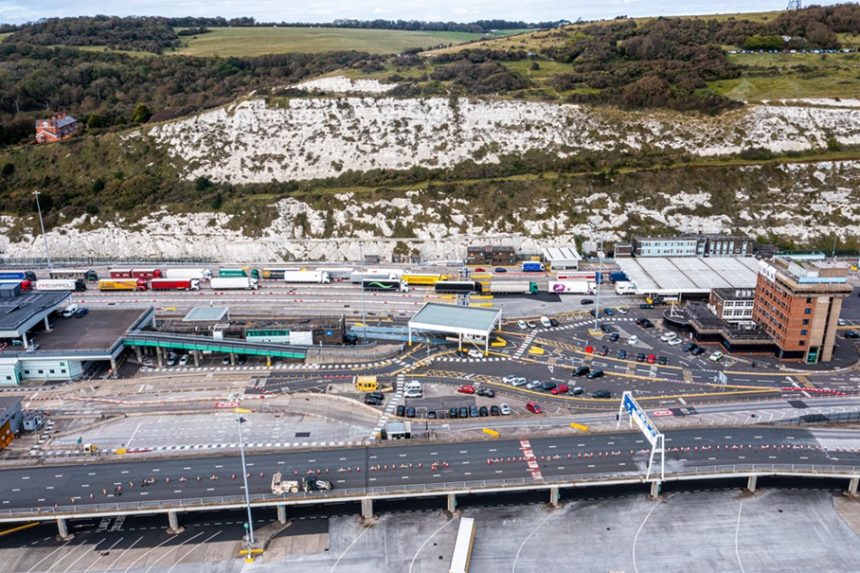
Ministers are pushing French authorities and the European Commission “on a daily basis” to use flexibilities currently available in the Schengen-area Entry/Exit System (EES) to prioritise the flow of travellers over full compliance with the scheme at locations with juxtaposed border controls, including the Port of Dover.
Such a message was conveyed by Minister for Border Security and Asylum Alex Norris during a Commons debate about EES on 8 July. He was responding to Sir Roger Gale MP, who pointed to EES “chaos” at Dover over the spring bank holiday weekend and fears of the same unfolding during coming weeks amid the summer travel peak.
Sir Roger claims that French authorities “were… not prepared or able to implement the facilities properly” earlier this year. He believes that booking numbers for the summer have already led to some forecasts that there could be 12-hour delays for outgoing traffic at Dover.
Mr Norris should approach French border authorities “and suggest that a waiver must be put in place before the holiday season starts so that we do not again face the chaos that we faced in May,” Sir Roger continues.
In response to Sir Roger’s call for more efforts, the minister notes how EES functions is complex. “When volumes peak shortly, the fundamental question will be prioritisation of flow or of compliance with the scheme,” Mr Norris continues. “We are pushing heavily, as we will every day between now and then, to ensure that the French use the flexibilities to prioritise flow.”
Debate participant Matt Vickers MP has suggested that a “separate new online system to preauthorise entry to the EU will be delayed until next year.” He is referring to a long-promised but as yet undelivered app to allow the submission of some required data to French authorities before arrival at the border.
Mr Norris says that the government is working with EU member states to push them take up the app. “I do not detect a lack of intent. They are keen to engage with us, and we engage with them frequently.”
Some debate participants suggest that part of the reason for EES delays at Dover is that despite investment in infrastructure at the port, some associated software is not working correctly.
Dave Parry, Managing Director of coach operator Parrys International, previously complained of “catastrophic delays” at Dover in late May, with some vehicles catching ferries four hours later than booked. Mr Parry’s MP Gavin Williamson has agreed to meet with him to discuss the matter in a continuation of support already offered.
On the early July Westminster debate, RHA has aired pleasure that MPs have shined a light “on how EES is unfit for purpose” and that the coach industry is among sectors most affected by its failings.
Trade Policy Lead Alastair Gunn adds that “inconsistent” use of biometric systems is causing concern, and that the delays – including at Calais on return journeys – are “creating serious problems for coach companies taking British tourists in and out of the EU.”
Mr Gunn says that RHA looks forward to engaging with new ministers appointed over coming weeks around the full impact of EES on the coach and haulage sectors, while at the same time currently believing that the system “is not yet properly understood in government.”