
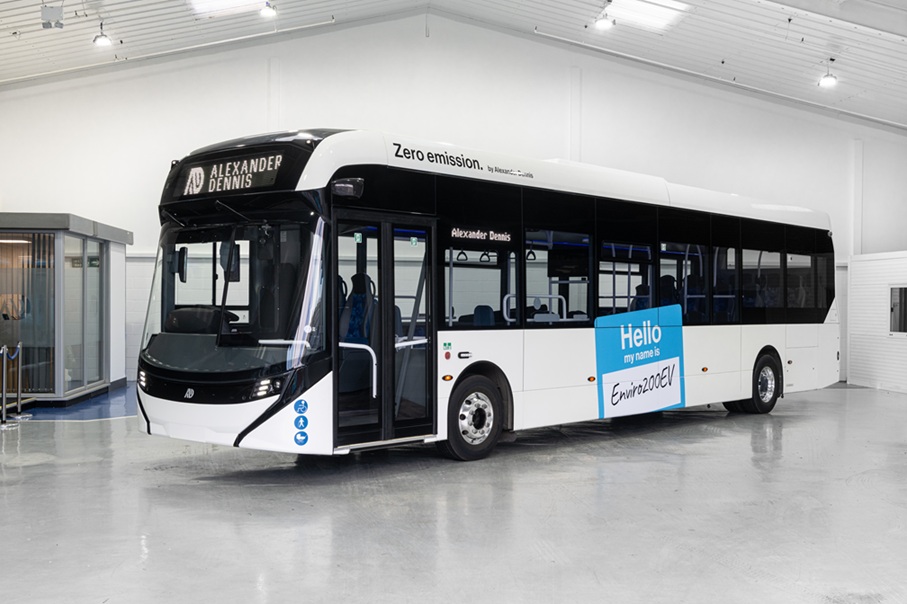
Alexander Dennis has shown a first test and development example of its Enviro200EV next-generation battery-electric single-deck bus, with the builder confirming that all production examples will be assembled at its plant in Scarborough.
The first of those customer vehicles are four bound for Go North East. They are 10.9m long, have been completed, and are for delivery to the Go-Ahead Group subsidiary soon.
From there will be built further 10.9m examples ordered by Falcon Buses and by First Bus for its operation in Bath, while in an echo of its work with the next-generation Enviro400EV double-deck, Alexander Dennis also plans to construct a number of maximum-length 11.7m variants that will be supplied to large operators as field trial vehicles.
President and Managing Director Paul Davies notes how getting the new Enviro200EV into service is now the priority. While a handful of prototypes have Chinese involvement in their assembly, news that production vehicles will be built in Scarborough ends the previous possibility that shells could come from China, as is the case for the smaller Enviro100EV.
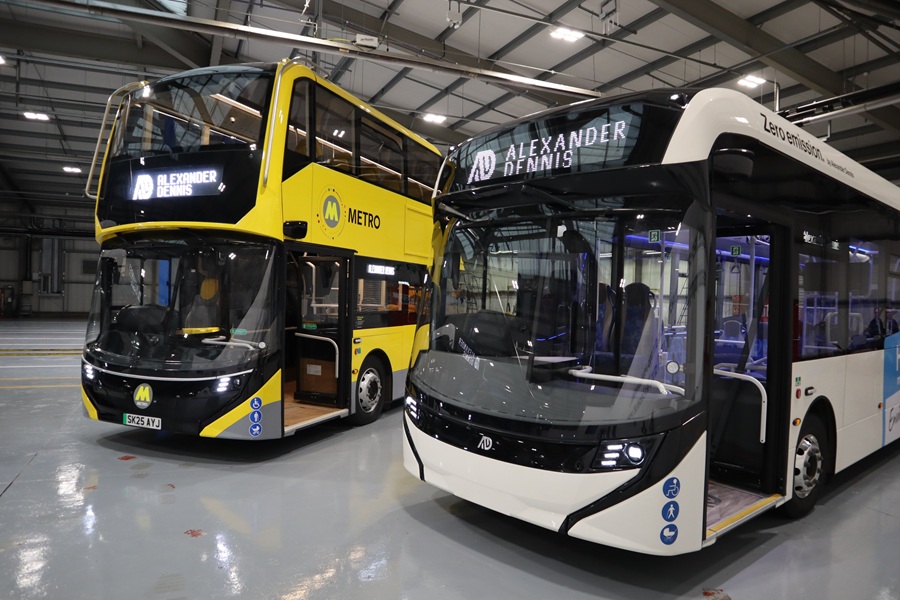
Collaboration on bids to the third round of the Scottish Zero Emission Bus challenge fund (ScotZEB3) saw Alexander Dennis display the Enviro200EV alongside the Enviro100EV and the Enviro400EV at its Larbert headquarters on 20 and 21 January.
That saw representatives of operators and the wider bus industry in Scotland visit to learn more about and sample the range. Paul notes how the builder is confident that orders for its products will be forthcoming from ScotZEB3, to which up to £45 million has been put by the Scottish Government.
Transport Scotland has relaxed the consortium-only position of the previous round to one where operators may also bid on a standalone basis, and the manufacturer is engaging with partners towards developing bids under both of those conditions.
Commercial and Legal Director Julie Thomson notes how ScotZEB3 requires significant detail, but she adds that the builder is used to such a structure via work with Combined Authorities in England that are procuring buses for franchised networks.
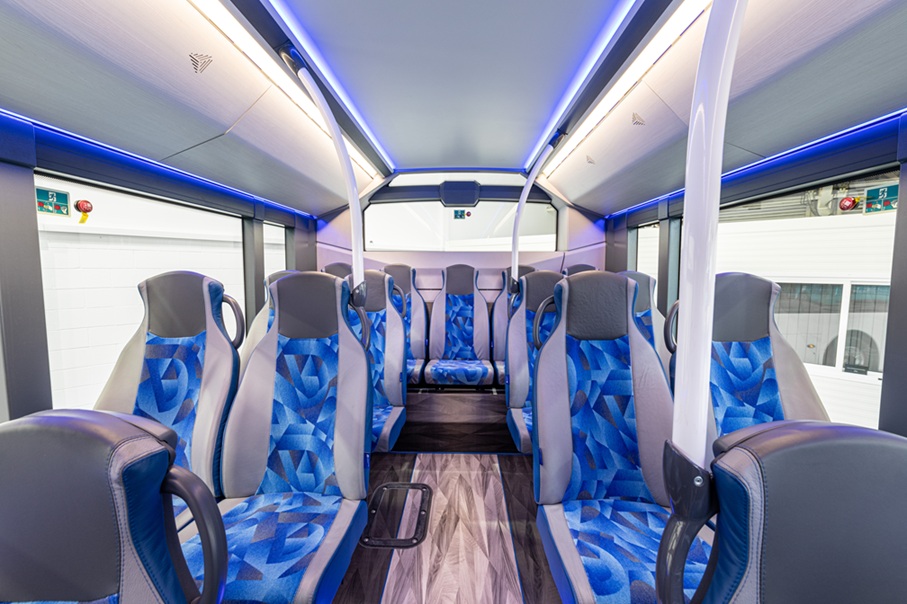
Underlining previous comments from Engineering Director Chris Gall, Paul explains that key to the Enviro200EV is how it builds on the long-established Enviro200 diesel model’s approach of being a highly accessible bus with an attractive passenger environment.
He is forthright in a view that certain of the saloon layout niceties delivered in modern diesel buses have been sacrificed in some electrics in the name of accommodating batteries and other components. The latter vehicles have been “commoditised” to an extent, Paul believes. “We are unwinding some of that.”
Use of 19.5-inch rims and maximising the wheelbase are important contributors to such work in the Enviro200EV, he continues. The smaller wheels are enabled by a lightweight approach, and they reduce intrusion into the passenger area.
As a result, the raised rear section is not as pronounced as on some full-weight diesel or electric buses. Even at its highest, a person of 6ft can stand straight there without touching the ceiling, while there are no modesty issues relating to position of raised seats and the window line.
“We are two tonnes lighter than anyone else,” Paul says of the full-length Enviro200EV. The bus will be available in provincial and Transport for London (TfL) specifications at 9.9m, 10.9m and 11.7m, while a TfL-only variant at 10.4m rounds off the new product.

A further benefit is the extent of seating that can be reached without encountering a step. The 11.7m test and development bus, which has two wheelchair user bays, gives 16 forward facing positions in the low-floor area. Two more are above the offside front wheel on a platform, while each wheelchair user bay has three tip-ups.
Maximum total seating capacity in the 11.7m variant is 41 with two wheelchair user spaces and 43 with one. The development vehicle uses the Lazzerini Practico seat, where forward-facing positions are provided with a console that has a device holder, USB charging point, and stop request button.
Drive is taken via the Vehicle Electrical Drive System (VEDS) from Driventic. It is a rebadge of the established Voith Electrical Drive System following carve-out of Driventic from Voith.

Buyers can select from medium-duty or heavy-duty iterations of VEDS. Paul believes that the latter will have merit where higher average speeds are needed or potential future redeployment is in mind, although it is less beneficial in smaller Enviro200EV variants.
400kWh of energy storage from CATL using lithium iron phosphate chemistry is standard. It is split between the roof and what would otherwise be the engine bay.
That is a difference from the Enviro100EV and Enviro400EV, which use batteries from Impact Power; packaging in those buses requires some energy storage to sit within the chassis, to which the Impact Power batteries are well suited, but that is not the case for the newcomer.
Realistic energy consumption figures for the Enviro200EV have not yet been generated, but Paul points to excellent performance of the Enviro400EV in Zemo Partnership testing as an indicator of what is expected.
Lightweight construction and the efficient VEDS driveline are contributors to that optimism, but in an indication of the depths of consideration around overall energy usage, he adds that a lower overall height than competitors by up to 20cm means less interior volume to heat or cool, giving a further power consumption influence.
Lightweighting has relevance in other areas, the Alexander Dennis chief continues. Resulting lower energy usage means that when charged over a defined time, peak power draw is lower, and that ultimately is reflected in the total burden on the grid from a depot.
Body structure has been optimised for weight while recognising the significant battery mass on the roof. Lessons around strength in the right places have been learned from the earlier BYD AD Enviro200EV body; the new model’s upper batteries sit between the axles and behind them is the heating, ventilation and air-conditioning unit.

Tall side windows meet the roof fairings at the cantrail, which minimises the number of ‘joins’ on the next-generation bus. CCS2 sockets can be fitted to both sides at the rear, with 150kW the maximum power that can be accepted by that means.
Roof-mounted rails for inverted pantograph-based opportunity replenishment are optional, and fitted to the test and development bus. It also has a camera monitoring system, but conventional mirrors will be offered.
With the first customer deliveries approaching, introduction of the full next-generation Alexander Dennis battery-electric range in the UK is nearly complete. Given events over the past six months, that position is welcome, Paul observes.
“We have been playing catch-up on single-deck and had to wait longer than we would have liked. But we are now ready to service the market,” he says. Yet customer pressure on lead times for new buses “does not let up,” and thus an element of stock build may figure in the longer-term Enviro200EV outlook.
More on the Enviro200EV will follow in the February print issue of routeone.